


Search
Key Takeaways: Nextdoor for Financial Advisors
Nextdoor is an underused, high-intent local pipeline channel for financial advisors, and the case rests on three things: you're reaching the actual decision-maker at the moment they're most likely to act, trust on this platform already favors expertise over price and brand, and the audience is quietly looking for help rather than resisting it.
Nextdoor's own research puts a number on the opportunity: 58% of neighbors say they're likely to hire or switch advisors in the next twelve months. Almost no advisor is currently running ads against that intent. The rest of this article makes that case in full, then shows exactly how to build a business page, launch compliant ads, and test the channel in 90 days without a large budget or a big commitment.
What is Nextdoor? A Quick Primer for Financial Advisors
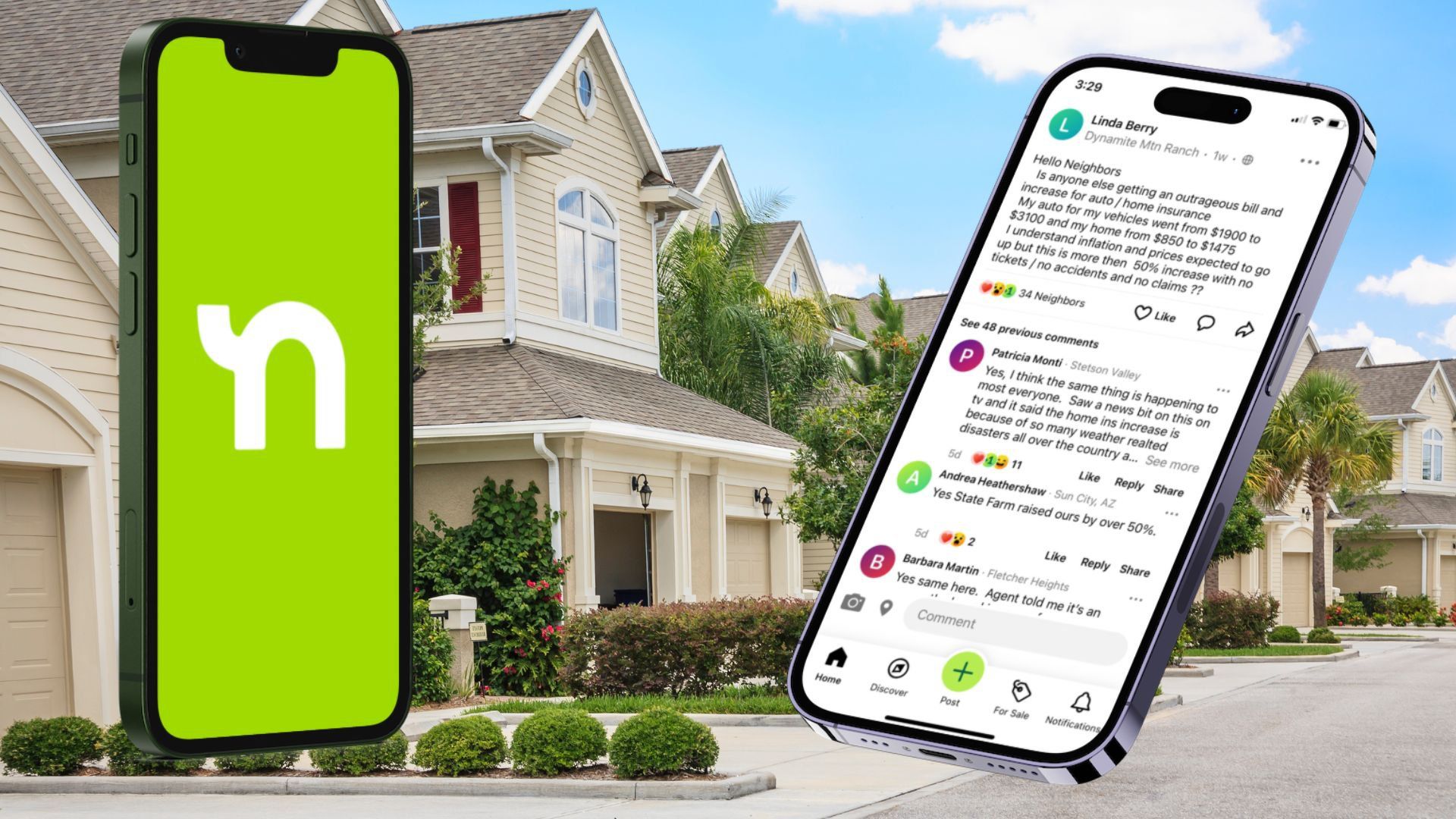
If your mental image of Nextdoor is still "the app where people post about a suspicious van on the corner," you're not wrong, but you're also about a decade out of date on what it's become for businesses.
Nextdoor is a social network organized around real, verified neighborhoods instead of friend lists or follower counts. When someone signs up, they confirm their home address.
That single detail is the reason this platform behaves differently than everywhere else you're probably already advertising: there's no anonymous handle, no fake location, no random stranger three states away weighing in on who's a good financial advisor. Every recommendation, post, and review comes from someone who actually lives in the neighborhood they're talking about.
For a business, three layers matter, and they build on each other:
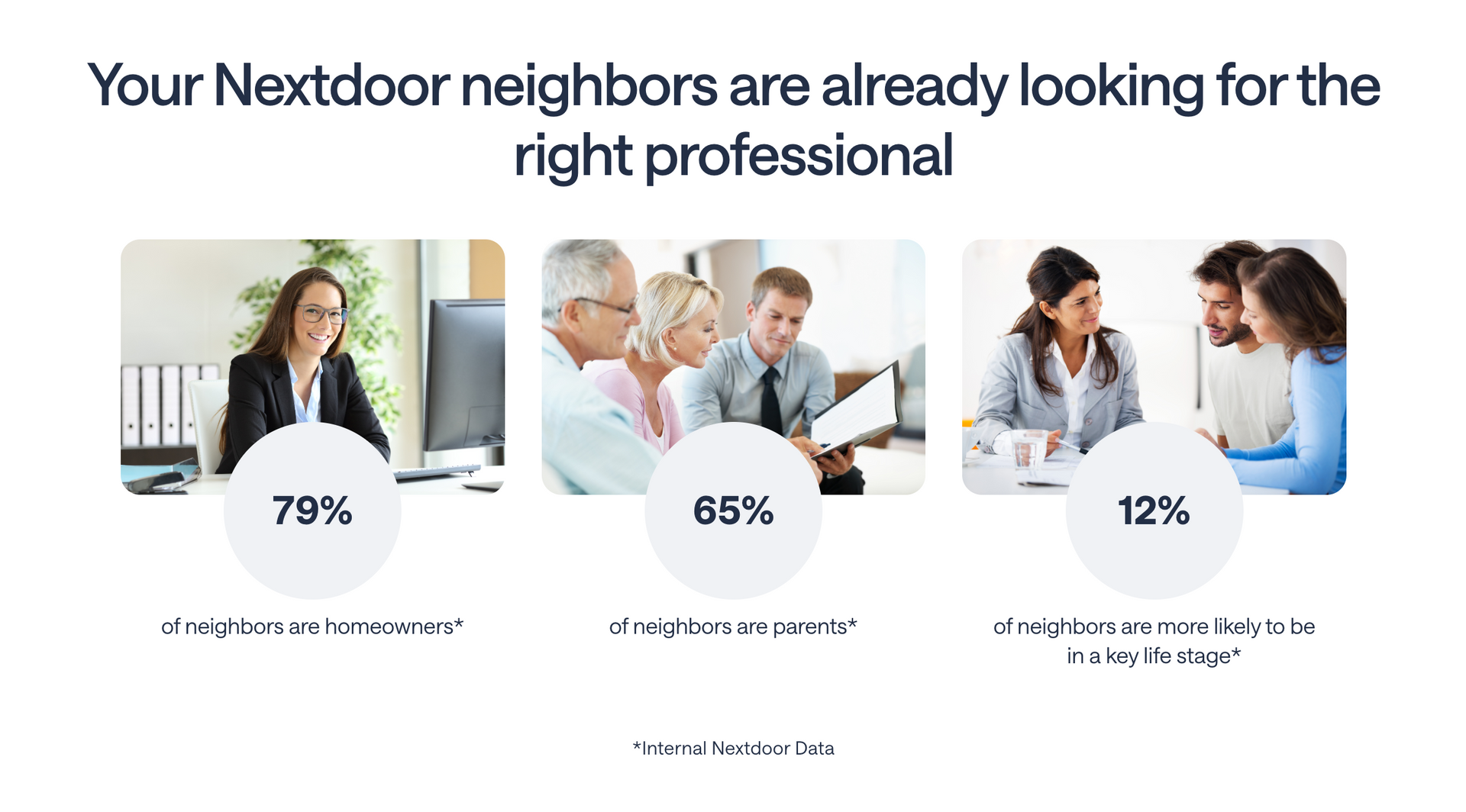
The business page is your home base, free to claim, and what neighbors find when they search for a financial advisor nearby or click through from a recommendation.
The neighbor feed is where organic activity happens. Neighbors ask for recommendations directly ("anyone have a financial advisor they trust for retirement planning?"), and businesses with a claimed page can respond or post into relevant local conversations. This unpaid layer is arguably the most valuable real estate on the platform for a trust-based profession.
Paid ads sit on top of both. Once you have a page and understand how organic conversations flow, advertising puts your name in front of specific neighborhoods, life stages, and triggers instead of waiting to be found.
Most advisors who've heard of Nextdoor stop at the first layer, if they've thought about it at all. That's the opportunity: the businesses winning here treat all three layers as one system.
Why Nextdoor Works for Financial Advisors: Three Reasons, Backed by Nextdoor's Own Data
The
statistics below come from Nextdoor's own 2026 research on financial advising specifically, based on a July 2026 Nextdoor survey and internal platform data from July 2024 to July 2026. We're citing it directly and by name because a claim this specific deserves a traceable source, not a vague "studies show.
Reason 1: You're reaching the right person, at the right moment
The decision-maker problem is the first thing that sinks most local advertising: you're often paying to reach someone who has to go convince a spouse or partner before anything happens. On Nextdoor, 62% of users are the primary financial decision-maker in their household, 22% higher than the general population. Your ad is landing directly on the person who signs the paperwork.
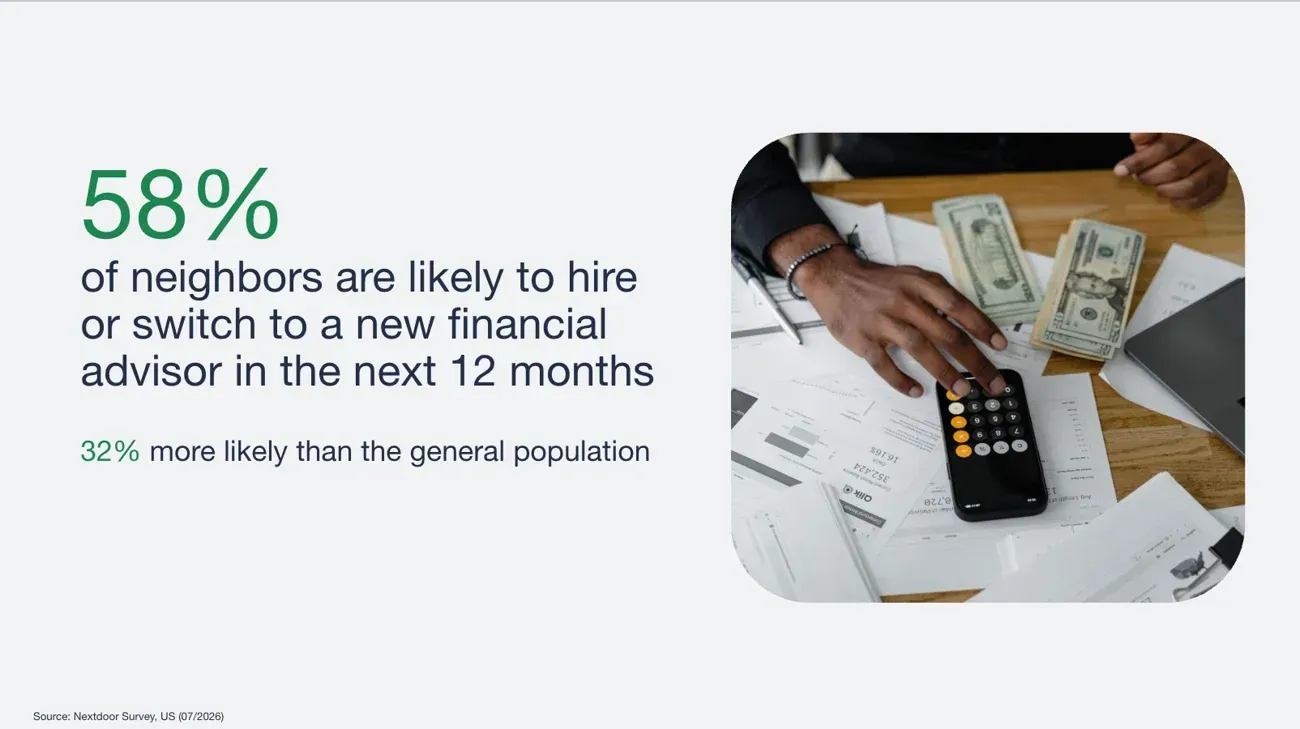
Timing compounds that advantage. 58% of neighbors say they're likely to hire or switch to a new financial advisor in the next twelve months, 32% above the general population, and it isn't random who moves. Having a child under 18 increases switching likelihood by 112%. Starting a new job increases it by 86%. Those are addressable, targetable moments, not abstract demographics. And the people who do switch mostly aren't unhappy: they cite growing financial complexity, a desire to consolidate accounts, or a need for specialized help like estate planning. That's an upgrade decision, which is a very different pitch than a breakup.
Reason 2: Trust on this platform already favors expertise over price
72% of neighbors have engaged with financial products, services, or advisors on Nextdoor in the past six months, and neighbors are 40% more likely to trust a fellow neighbor than an influencer. That trust dynamic changes what actually wins new clients here: 71% say relevant expertise is the top factor in choosing an advisor, ahead of firm reputation and cost or fees, which tie at 66% each. Online reviews come in at 53%.
That ordering matters more than it looks. If you're a smaller firm competing against a wirehouse with ten times your budget, you likely can't out-discount them and probably can't out-brand them, but you can out-specialize them. This is also structurally a referral platform before it's an ad platform: 22% of people found their current advisor through a referral from family or friends, 19% through another professional, and only 18% through online search. Advertising here means plugging into an existing word-of-mouth system, not fighting against one.
Reason 3: The audience is quietly looking for help, not resisting it
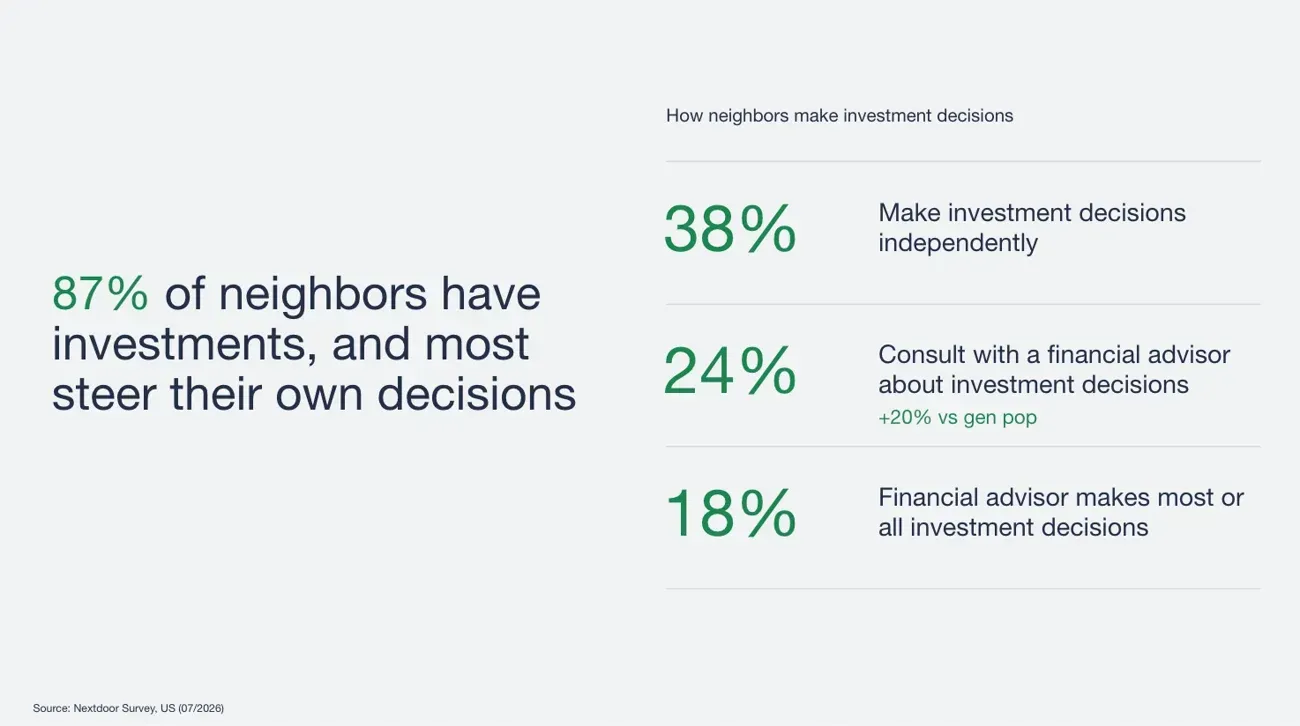
87% of neighbors already have investments, but only 18% let an advisor fully lead those decisions, and 38% invest entirely on their own. Read in isolation, that looks like a self-sufficient audience that doesn't want an advisor. It isn't: 55% say managing their finances is stressful or overwhelming. That's not confidence, that's someone going it alone because nobody's made the case for why they shouldn't have to.
The implication for messaging is direct. Lead with reassurance and complexity-reduction, not a pitch about outperforming the market. Financial-advising conversations on Nextdoor are up 26% year over year, which suggests this window is opening, not static.
One honest limitation, stated plainly: this isn't a volume channel. Nextdoor won't fill a pipeline the way paid search can at scale. What it offers is a smaller, higher-trust audience at the specific moment they're deciding. Treat it as a precision layer on top of an existing strategy, not a replacement for one.
How to Create a Nextdoor Business Page for Financial Advisors
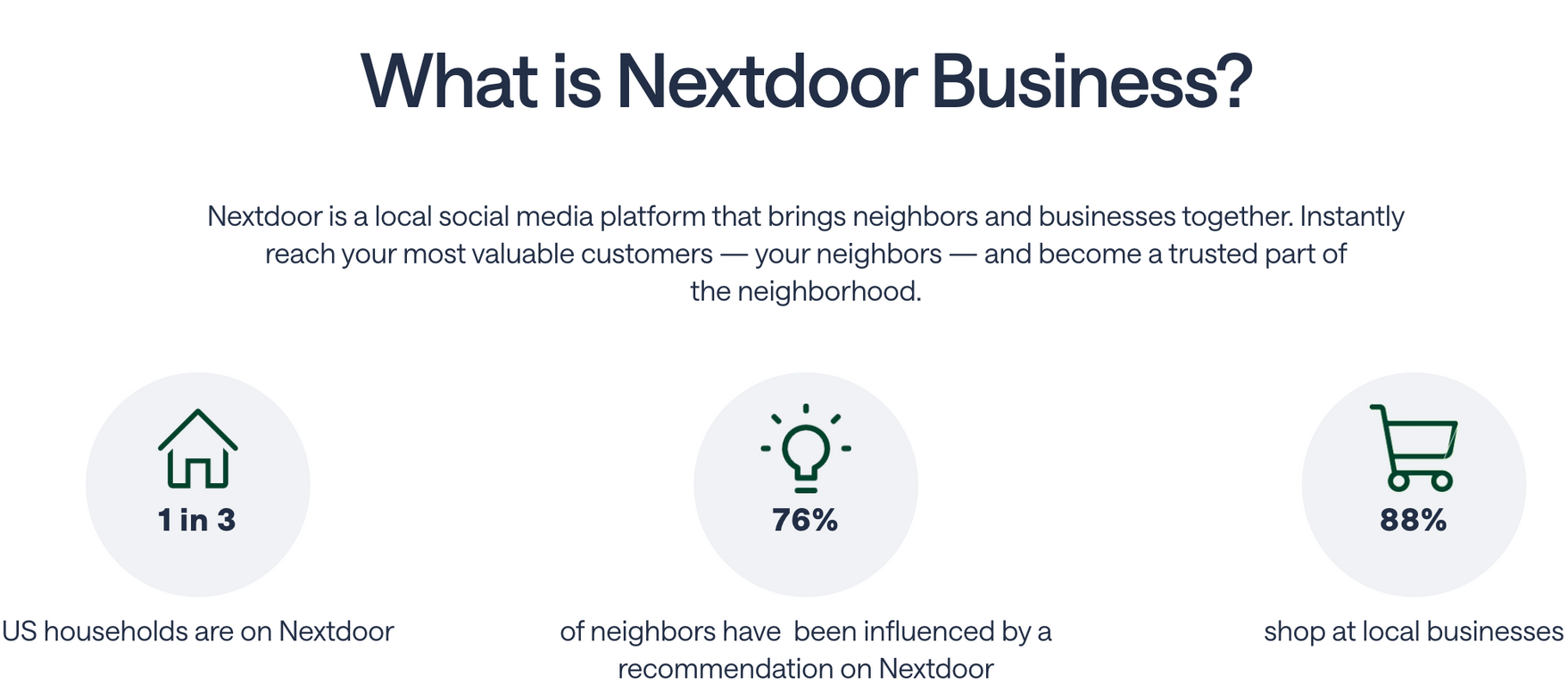
A claimed page that looks unfinished undercuts everything in the section above. Here's how to build one that actually earns the trust this platform runs on.
Claim your page first. Nextdoor's business sign-up flow lets you claim a page as the owner, an employee, or another authorized rep. If you already use Nextdoor personally, you can attach the business page to your existing account. This takes minutes.
Pick your category, and use more than one. "Financial advisor" sits inside Nextdoor's broader financial services category grouping. You can add up to ten category tags — retirement planning, estate planning, whatever your actual niche is. Category tags drive when you surface in search, and given how much expertise matters in advisor selection (see Reason 2 above), under-tagging is pure lost visibility.
Write a Story section that says something specific. Most business pages read like a stock "About Us" paragraph nobody remembers. Explain who you actually help and why, with a real local tie woven in. A generic bio is a wasted opportunity on a trust-based platform, not a neutral one.
Show your license number. Nextdoor explicitly recommends this for licensed providers, and on a platform where "can I trust this person with my money" is the first question in every neighbor's head, it does real credibility work.
Fill the photo gallery with real people and places. Your actual office, your actual team, a real local event. Skip stock photography entirely — neighbors can tell the difference, and it's often the first place that distinction shows up.
Then keep showing up. A claimed page that goes quiet is barely better than no page. A sustainable rhythm looks like:
- Responding to neighbor threads asking for advisor recommendations — the single highest-trust, lowest-cost moment on the platform.
- Posting seasonal, useful content tied to real financial moments: tax season, open enrollment, year-end planning, market volatility when it happens.
- Engaging like a neighbor, not a brand account.
Twenty minutes a couple times a week is enough to keep a page genuinely alive, which already puts you ahead of most advisors currently on this platform.
How to Advertise Financial Services on Nextdoor: Promoted Posts, Local Deals, and Sponsorships— Explained
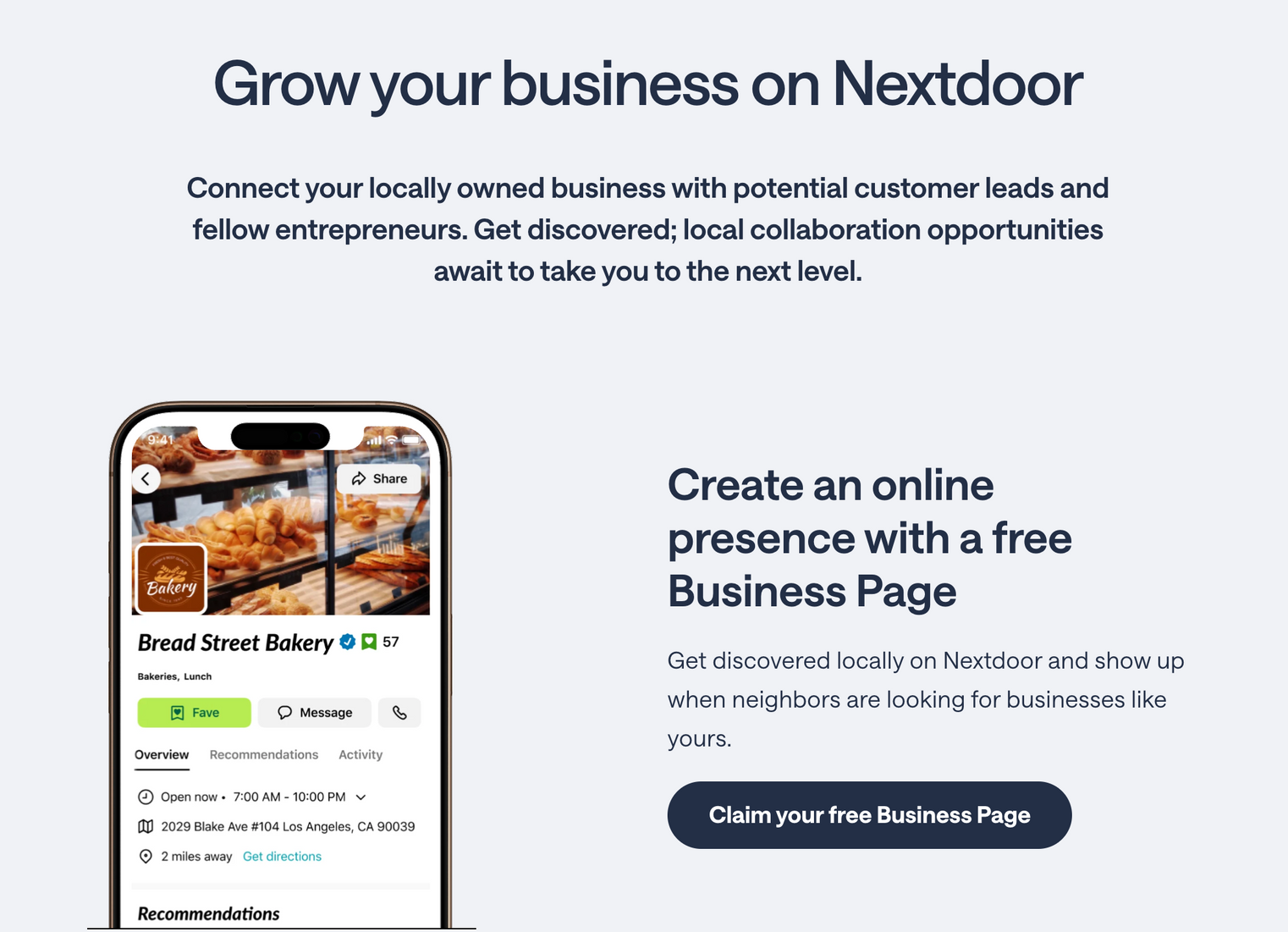
Paid is how you stop waiting to be found and start reaching the neighbors most likely to need you right now. Nextdoor has three distinct ad products, and conflating them is the most common mistake advisors make once they start spending here.
Promoted Posts are the entry point: self-serve, auction-based, set up yourself through Ads Manager with no sales rep and no minimum spend most independent advisors can't justify. Real-world CPCs typically run $2.50 to $3.50. A monthly budget in the low hundreds is a realistic starting point for a solo or small practice. Nearly everyone reading this should start here.
Local Deals run an offer rather than boosting a post — a free portfolio review, a no-obligation consultation. This maps directly onto Reason 1 above: 58% of neighbors are already open to switching, so meet that intent with a low-barrier offer instead of more education.
Neighborhood Sponsorships are direct-sales, sold through Nextdoor's team, with pricing running into four figures a month per neighborhood. This fits a multi-advisor firm or RIA with real budget and a specific reason to dominate share of voice in a handful of neighborhoods, not a solo advisor's starting point.
Targeting is where the platform earns its keep. Beyond homeownership, age, income, and interests, the highest-leverage lever is life-stage targeting: new parents (112% higher switching odds) and recent job changers (86% higher). Creative should speak directly to each: 529 plans and family protection for one group, 401(k) rollovers and equity comp for the other.
Creative tone matters more here than almost anywhere else you advertise. This isn't the platform for a polished, agency-produced spot. Neighbors respond to peer-credible, neighborly creative — testimonial-style language, "recommended near you" framing. And per Reason 2, lead with expertise and credentials, not price; creative that competes on fees is fighting the wrong battle on this specific platform.
Measure consultations, not clicks. Install the Nextdoor Pixel or Conversion API for attribution, but track booked calls and qualified conversations as the real metric. Click-through rate is a secondary signal at best for a lead-gen business like advisory services.
Start with Promoted Posts in your own neighborhood and one or two adjacent ones. Test a single low-barrier Local Deal once your page has organic credibility behind it. Everything past that should be earned by what converts, not assumed on day one.
SEC Marketing Rule and FINRA Compliance for Nextdoor Advertising
This section is educational and general in nature, not legal or compliance advice specific to your firm. Confirm any Nextdoor marketing approach with your firm's compliance team or outside counsel before publishing.
Your posts can count as advertisements, even the free ones. The SEC's Marketing Rule (Rule 206(4)-1) defines "advertisement" broadly enough to include organic content promoting your advisory services, not only paid campaigns. A business page post, a reply to a neighbor's recommendation request, a Promoted Post — all of it can fall under the same standard. Treat Nextdoor activity with the same care you'd apply to any other channel carrying your name and your firm's name.
Recommendations are the heart of this platform, which is exactly where disclosure rules matter most. A neighbor's recommendation in the feed is functionally a testimonial. If you repost it, screenshot it into an ad, or actively encourage clients to leave one, the Marketing Rule requires disclosing whether the person is a current client and whether they were compensated in any way, including non-cash compensation like a fee discount.
Broker-dealer affiliation brings FINRA Rule 2210 into play as well, which governs public communications and can layer additional restrictions on top of the SEC rule. Route Nextdoor content through your firm's existing review process, not a separate, more casual one.
Keep records of what you post. Regulators expect firms to reproduce marketing content exactly as it appeared, along with the approvals behind it. A simple screenshot-and-log habit covers this.
None of this should discourage testing the platform. It means Nextdoor content belongs inside your existing compliance workflow rather than off to the side because it feels more casual than a formal campaign. If you want a second set of eyes on this kind of review without adding it to your own plate, that's the specific gap our FinComply tool is built to close.
A 30/60/90 Day Plan for Testing Nextdoor Advertising
Days 1-30: Build the foundation. Claim your page, write a specific Story section, add your license number, tag every relevant category, and load real photos. Start engaging organically in your own neighborhood and two or three adjacent ones: respond to recommendation requests, post something tied to a real financial moment once a week or so. No ad spend yet — the goal is a page worth sending traffic to before any traffic arrives. If you mention your page to existing local clients, remember the same testimonial disclosure rules above apply if you're actively soliciting recommendations.
Days 30-60: Run one small, deliberate test. Pick a single ad product — a Promoted Post or Local Deal, not Sponsorships — and keep geography tight. Keep the offer low-barrier and specific: a free 30-minute portfolio review, a no-obligation consultation. A few hundred dollars a month is a realistic budget given $2.50-$3.50 CPCs. Layer in life-stage targeting around new parents or recent job changers if your audience data supports it; if not, start broader and refine later. Write one piece of creative and let it run without constant tinkering.
Days 60-90: Evaluate on outcomes, not vanity metrics. Look at booked calls and real conversations, not just clicks or impressions. If it worked, expand deliberately — more neighborhoods, more budget, a second offer tested against the first. If it didn't produce results, check whether the page itself was doing its job and whether organic activity gave the ad any credibility to land on before concluding the channel failed. A cold ad running against a bare page is a different experiment than a genuine test of the channel.
Either way, ninety days and a modest budget buys a real answer, for less than most advisors spend on a single conference sponsorship that produces nothing measurable at all.
The Bottom Line on Nextdoor Marketing for Financial Advisors
Return to where this article started: 58% of the neighborhood you're trying to reach is open to hiring or switching advisors this year, you're reaching the actual decision-maker when you do, and trust on this platform already rewards expertise over price. That combination is a documented buying signal on a channel almost nobody in this industry is using yet.
Testing it doesn't require overhauling your marketing. It requires a real business page, some organic presence, and one small, honest campaign.
If you want the shortcut version of everything in this article, grab our Nextdoor Business Page Checklist for Financial Advisors — category tags, Story section prompts, license and photo requirements, your first five posts with examples, and a compliance gut-check before you publish anything.
If you'd rather have this built for you between client meetings, that's what a Digital Clarity Session is for: a look at where your firm actually stands, whether Nextdoor fits your specific pipeline, and what a real 90-day test looks like for your practice.
The neighborhood conversation about who to trust with real money is already happening. The only question left is whether your name comes up in it.
Sources & Methodology
Primary statistics on financial-advising behavior (switch intent, decision-maker status, trust and expertise rankings, investment behavior) are drawn from Nextdoor's own published research: "The Trust Economy in Financial Advising on Nextdoor," Nextdoor Business Blog, based on a Nextdoor-fielded U.S. survey (July 2026) and internal platform data (July 2024-July 2026). Platform-scale and demographic figures (user base size, homeownership skew, income and age concentration) are drawn from a mix of Nextdoor's own disclosures and third-party industry sources, and are presented as directional ranges rather than precise figures given some variance across sources. Advertising cost figures (CPC ranges, sponsorship pricing) reflect typical reported ranges as of mid-2026 and will shift over time; confirm current rates in Nextdoor's Ads Manager before budgeting. This article does not constitute legal, compliance, or investment advice.
Author: Logan Brown
Logan Brown is the founder of WealthSites, where he builds websites and marketing systems exclusively for independent financial advisors and RIAs. After 13+ years in marketing, including nearly seven years working inside the broker-dealer channel at Independent Financial Group and LPL Financial, he started WealthSites to focus on the one thing he'd spent a decade learning: what actually earns a prospective client's trust before they ever pick up the phone. His work on the Beyond Wealth Partners campaign was a Wealthies finalist for Client Digital Campaign of the Year. He holds a B.S. from Indiana University's Kelley School of Business.
Outside of work, Logan is based on the Big Island of Hawaii, where he's usually found working on woodworking projects, growing pineapples and mangoes in his garden, and traveling with his wife and son.
You may also like